ChatGPT Ads vs SEO vs AEO: Key Differences in 2026 Copy title
Understand the difference between ChatGPT Ads vs SEO vs AEO. Explore how paid AI advertising, organic search optimization, and Answer Engine Optimization work, their benefits, and how businesses can choose the right digital marketing strategy in 2026.

ChatGPT Ads vs SEO vs AEO: Understanding the Difference
Businesses are no longer relying on just one way to reach customers online. People discover brands through Google Search, paid advertising, AI-powered search experiences, and conversational platforms such as ChatGPT. This change raises an important question: should your business invest in ChatGPT Ads, traditional SEO, or Answer Engine Optimization (AEO)?
The answer depends on your goals, audience, budget, and how customers discover your products or services.
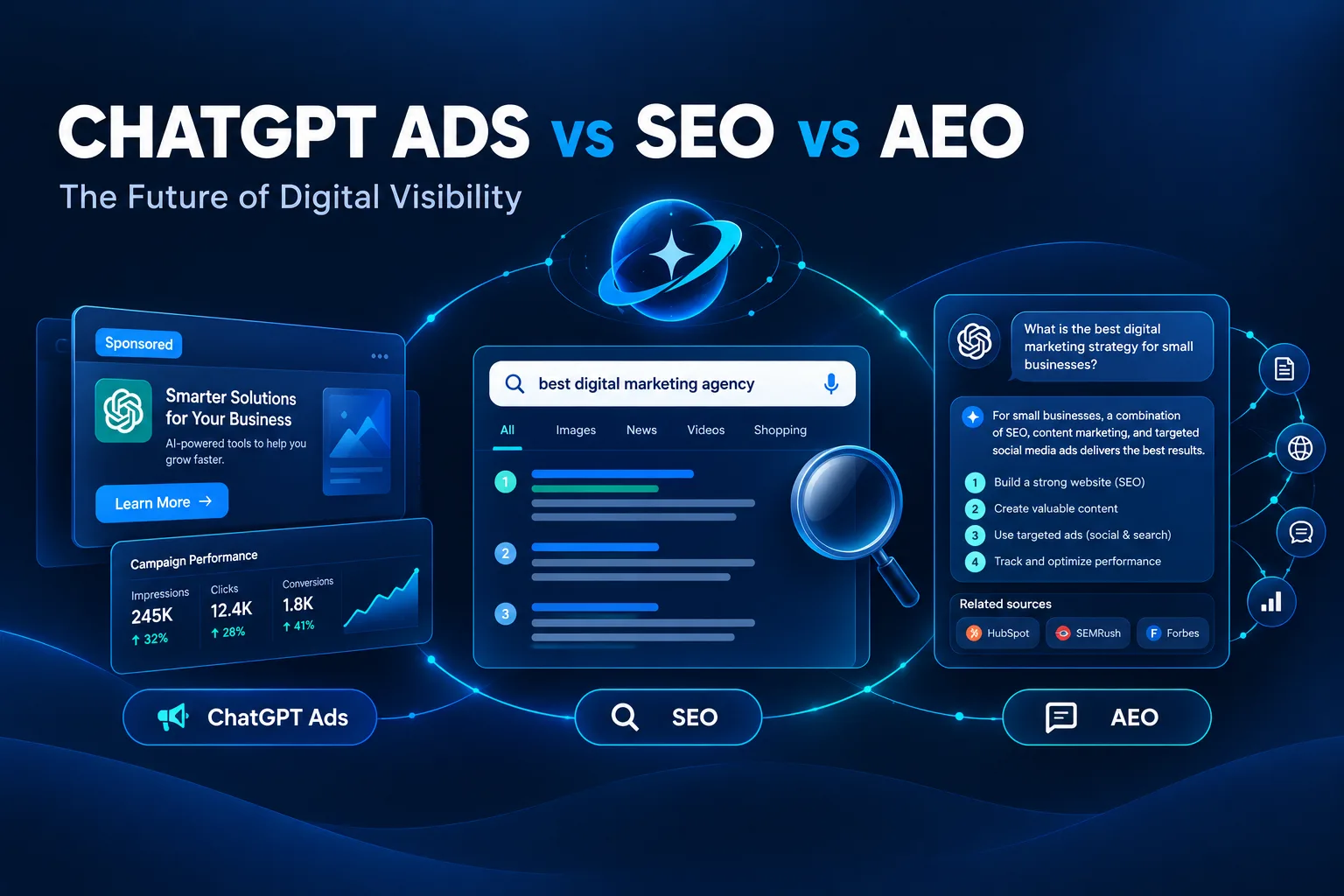
ChatGPT Ads help businesses reach people through paid placements in ChatGPT. Search Engine Optimization (SEO) focuses on improving a website's visibility in organic search results. Answer Engine Optimization (AEO) focuses on making information clear, useful, and easy for answer engines to understand and potentially reference.
Although these strategies serve different purposes, they can complement one another.
In this guide, we will explain how ChatGPT Ads, SEO, and AEO work, compare their benefits and limitations, and help you decide where to focus your marketing efforts.
What Are ChatGPT Ads?
ChatGPT Ads are paid advertising placements that allow businesses to promote relevant products or services within the ChatGPT experience.
Instead of relying only on conventional search keywords, these ads can use conversational context to reach people while they explore options, compare alternatives, or make decisions. Ads are clearly labeled and kept separate from ChatGPT's answers.
For example, imagine someone asking ChatGPT to compare website development services for a small business. A relevant advertisement from a web development company might provide another option for the user to explore.
The advertisement is a paid placement, not an organic recommendation or a guarantee that the business is the best choice.
How ChatGPT advertising works
The advertising process generally involves:
Setting up an advertiser account where the platform is available.
Defining the campaign objective and relevant audience context.
Preparing advertising copy and a landing page.
Selecting bidding and measurement options supported by the platform.
Reviewing campaign performance and optimizing results.
The precise campaign options, eligibility requirements, and availability can change as the advertising platform evolves.
Benefits of ChatGPT Ads
1. Reach users during research
Businesses may reach potential customers while they are actively exploring a problem or comparing possible solutions.
2. Conversational context
Advertising can be aligned with the topic and intent of a conversation rather than depending exclusively on traditional keyword matching.
3. Measurable campaigns
Supported reporting can help advertisers evaluate impressions, clicks, spending, and conversions.
4. A new advertising channel
ChatGPT Ads offer another potential channel for businesses that want to diversify their customer acquisition strategies.
Limitations of ChatGPT Ads
ChatGPT Ads require an advertising budget, and performance is not guaranteed. Results depend on factors such as campaign eligibility, ad relevance, competition, landing-page quality, and the value of the offer.
Businesses should also verify current country availability, account eligibility, campaign options, and pricing before committing a budget.
What Is SEO (Search Engine Optimization)?
Search Engine Optimization, commonly called SEO, is the process of improving a website so search engines can discover, understand, and potentially display its pages for relevant searches.
For example, someone searching for “website development company in Rishikesh” may see organic results from businesses whose pages are relevant to that query.
Unlike paid advertising, organic search rankings are not purchased directly through an advertising bid.
How SEO works
SEO generally involves four key areas:
1. Technical SEO
Make sure search engines can crawl and index your website. This includes managing site structure, broken links, mobile usability, page performance, and indexing issues.
2. On-page SEO
Use descriptive page titles, clear headings, helpful content, relevant internal links, and meaningful URLs.
3. Content strategy
Create useful articles, service pages, guides, and resources that answer the questions your target audience actually has.
4. Authority and trust
Build credibility through original expertise, genuine references, quality content, and a consistent business presence.
Benefits of SEO
Can attract relevant visitors over time without paying for each organic click.
Helps businesses build long-term search visibility.
Supports brand credibility and customer education.
Can generate enquiries through service pages and informative content.
Can also support visibility in certain AI-powered search experiences.
Limitations of SEO
SEO takes time and consistent effort. Rankings and traffic can fluctuate, competitors may target the same queries, and publishing content does not guarantee search visibility.
Businesses should measure qualified organic traffic, enquiries, conversions, and revenue rather than focusing only on rankings.
What Is AEO (Answer Engine Optimization)?
Answer Engine Optimization, or AEO, is a term used for strategies intended to make information easier for answer-focused systems to understand and potentially surface in responses.
These systems may include AI assistants, conversational search tools, and search experiences that provide direct answers rather than only a list of links.
For example, someone might ask an AI assistant, “What should a small business look for when choosing a website development agency?”
A clear, informative website that explains relevant selection criteria, demonstrates real expertise, and provides accurate business information may be useful to systems answering that question.
However, no AEO strategy guarantees that an AI assistant will mention a particular business or cite its website.
How AEO works
A practical AEO strategy can include:
1. Answer questions directly
Start relevant sections with a concise answer before expanding on the explanation.
2. Use clear headings
Organize information into logical sections that address specific customer questions.
3. Provide accurate and useful information
Support claims with reliable evidence, practical examples, original insights, and current details.
4. Establish clear business information
Keep your services, contact details, company information, and relevant business profiles accurate and consistent.
5. Make content accessible
Ensure important information is available as readable text, pages are discoverable, and internal links help visitors navigate your website.
6. Measure results
Monitor referral traffic, relevant search visibility, leads, and other available evidence of AI-driven discovery.
AEO should not be treated as a collection of secret ranking tricks. Search and AI systems change, and there is no universal formula that guarantees inclusion in their answers.
ChatGPT Ads vs SEO vs AEO: Key Differences
Feature | ChatGPT Ads | SEO | AEO |
|---|---|---|---|
Main purpose | Paid visibility in ChatGPT | Organic search visibility | Potential visibility in direct answers |
Marketing type | Paid advertising | Organic optimization | Content and discoverability strategy |
Cost model | Advertising spend | Content, technical work, and ongoing effort | Content, technical work, and ongoing effort |
Time to results | Depends on campaign access and delivery | Often takes time to build | Depends on the system and whether content is surfaced |
Main focus | Relevant ad placements | Search engine discovery and rankings | Clear, trustworthy answers and information |
Traffic source | Paid placements in ChatGPT | Organic search results | AI answers and other answer-focused experiences |
Guaranteed visibility? | No | No | No |
Best measurement | Ad spend, clicks, conversions | Organic clicks, impressions, conversions | Available referral data, citations, mentions, and qualified leads |
One important distinction: ChatGPT Ads are an advertising product, whereas SEO and AEO are optimization approaches. They should not be compared as if all three were interchangeable services.
Is AEO Different From SEO?
Yes, in terms of emphasis, but the two overlap significantly.
SEO focuses on making a website useful and discoverable through search engines. AEO places additional emphasis on how clearly content answers questions and whether that information may be surfaced by answer-focused systems.
For example, consider a page explaining website development costs.
A traditional SEO approach may focus on relevant search intent, a descriptive title, useful cost breakdowns, internal links, and technical accessibility.
An AEO-oriented approach may additionally make the answer easy to identify by including a concise summary, a transparent pricing table, specific examples, and direct answers to common follow-up questions.
These approaches can work together. Google states that established SEO best practices remain relevant to its AI-powered search experiences, and it does not require special AI-specific markup to qualify for those features.
AEO should therefore strengthen useful content rather than replace SEO.
Can You Use ChatGPT Ads, SEO, and AEO Together?
Yes. For many businesses, a combined strategy is more practical than relying entirely on one channel.
Consider a website development company that wants to attract small-business clients.
Step 1: Use SEO to build organic visibility
Create helpful service pages and articles targeting relevant searches such as website development costs, website maintenance, and choosing a web development agency.
Step 2: Use AEO principles to improve clarity
Answer common customer questions directly. Explain your process, provide transparent service details, and demonstrate experience through genuine examples and case studies.
Step 3: Test ChatGPT Ads when appropriate
If eligible and available within your target market, test paid campaigns with a clear objective, a relevant landing page, and appropriate conversion tracking.
Step 4: Measure business outcomes
Compare the quality of enquiries, conversion rates, acquisition costs, and revenue. Do not judge a channel solely by its traffic volume.
Step 5: Improve based on evidence
Identify which pages answer customer questions effectively, which campaigns attract suitable prospects, and where visitors abandon the enquiry process.
This approach combines paid reach with organic discoverability and useful content.
Which Strategy Should Your Business Choose?
The right choice depends on your current situation.
Choose ChatGPT Ads if:
You want to test paid visibility within ChatGPT.
Your business is eligible to advertise in your target market.
You have a defined budget and a landing page designed to convert.
You can measure whether campaigns generate valuable enquiries or sales.
Prioritize SEO if:
You want to grow visibility in relevant Google searches.
Your customers actively search for the products or services you offer.
You can invest in useful content, technical improvements, and ongoing optimization.
Use AEO principles if:
Your customers ask detailed questions before making a purchase.
You want your website to communicate expertise clearly.
You want content that is easier for both people and answer-focused systems to understand.
For most small businesses, a sensible starting point is to build a strong website and SEO foundation, structure content around real customer questions, and test paid advertising when the economics and platform availability make sense.
How to Prepare Your Website for AI Search
Whether you are investing in SEO or exploring AEO, start with these practical improvements:
Make sure important pages are crawlable and eligible for indexing.
Create original content that genuinely answers customer questions.
Use clear titles, headings, descriptive links, and logical site navigation.
Keep business information, pricing, and service details accurate.
Add relevant examples, original research, images, or demonstrations where they improve the page.
Use structured data only when it accurately describes visible page content and meets the relevant guidelines.
Track search performance, qualified visits, and enquiries.
Avoid promises of guaranteed AI rankings, citations, or recommendations.
There is no need to publish dozens of near-identical articles or add unsupported technical tricks to every page. A smaller collection of useful, distinctive resources can be more valuable than a large collection of repetitive content.
Frequently Asked Questions
1. Are ChatGPT Ads the same as SEO?
No. ChatGPT Ads are paid placements within ChatGPT, while SEO focuses on improving organic visibility in search engines. Paid advertising can provide a separate route to visibility, but it does not guarantee organic rankings.
2. Can SEO help a website appear in AI answers?
It can help establish the technical accessibility, relevance, and quality needed for consideration by AI-powered search experiences. However, good SEO does not guarantee that an AI system will cite or mention a website.
3. Does AEO replace SEO?
No. AEO emphasizes clear answers and discoverable information, while many of its useful practices overlap with established SEO principles. Businesses should generally treat AEO as complementary to SEO.
4. Do small businesses need ChatGPT Ads?
Not necessarily. A business should evaluate its audience, budget, eligibility, expected acquisition costs, and ability to measure results before investing in a new advertising channel.
5. Can a business guarantee that ChatGPT will recommend it?
No legitimate optimization service can guarantee that ChatGPT or another AI assistant will recommend a particular company. Businesses can improve their online information and credibility, but the final selection of sources and answers is outside their control.
6. What is the best long-term digital marketing strategy?
For many businesses, it is a balanced strategy: a technically sound website, helpful SEO content, clear answers to customer questions, trustworthy business information, and paid campaigns when they make commercial sense.
Final Thoughts
ChatGPT Ads, SEO, and AEO serve different but complementary roles in digital marketing.
ChatGPT Ads offer a paid route to visibility within a conversational AI experience. SEO helps people discover relevant website pages through organic search. AEO encourages businesses to communicate accurate, useful information in ways that answer-focused systems may understand and surface.
The goal is not to choose a fashionable marketing term. It is to help the right customers discover your business, understand your value, and take the next step.
Start with a website that works well, content that answers genuine customer questions, and measurement that connects marketing activity to business outcomes. Then expand into new advertising and discovery channels based on evidence rather than hype.